

4 min read
Single-Point vs. Multi-Point Temperature Calibration: Which Do You Need?
 Joe Moser - CEO
Updated on June 23, 2026
Joe Moser - CEO
Updated on June 23, 2026
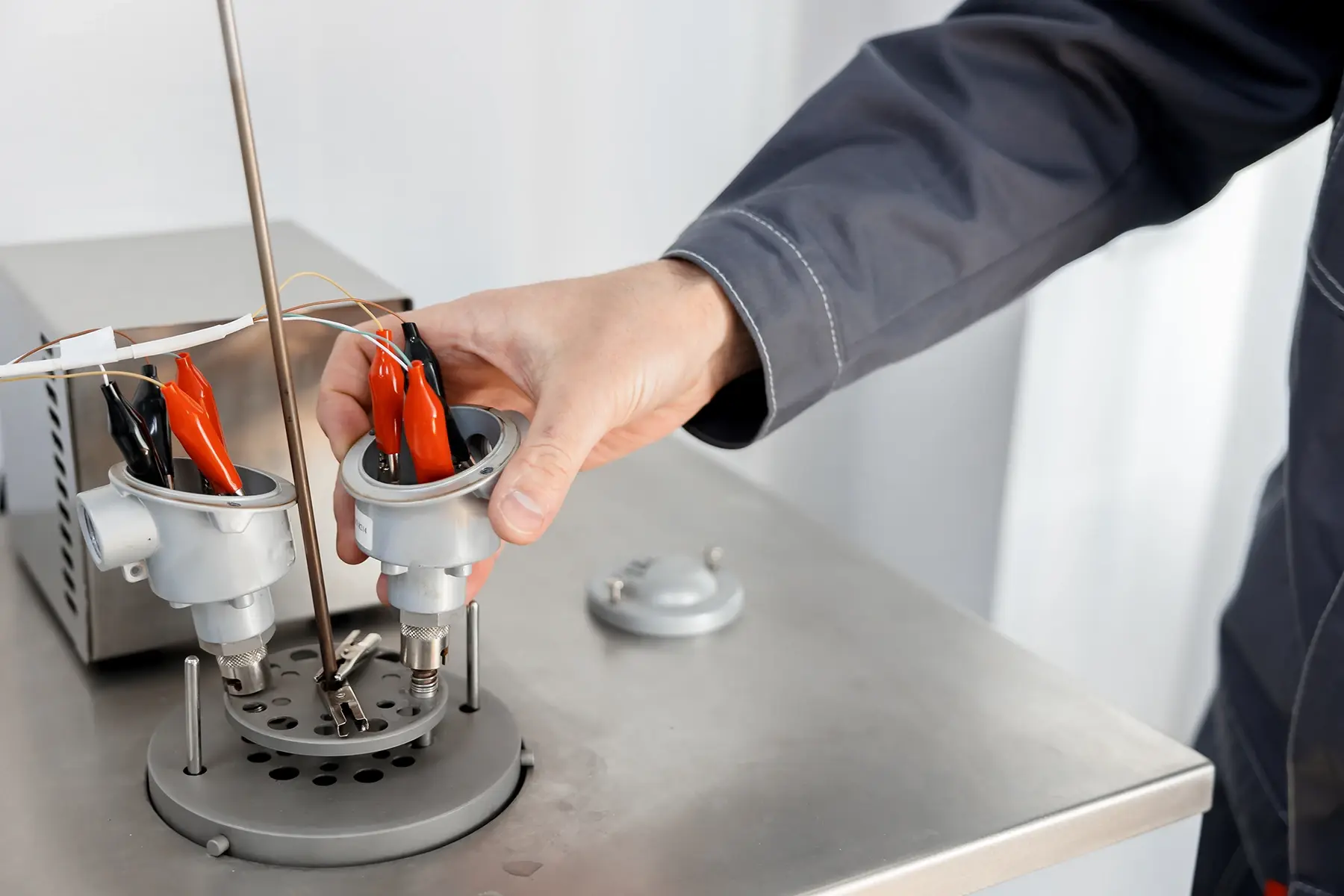
When you send a temperature instrument out for calibration or schedule an on-site visit, one of the first decisions that shapes the scope of that calibration is how many points will be tested. A single-point calibration checks accuracy at one reference temperature. A multi-point calibration checks accuracy across several points spanning the instrument's operating range.
That difference matters more than most people realize. Choosing the wrong approach doesn't just affect your calibration certificate — it affects whether your measurement data is actually defensible when it counts.
What Is Single-Point Temperature Calibration?
Single-point calibration verifies that a temperature instrument reads accurately at one specific temperature — typically the most critical point in the instrument's application, or a standard reference point like 0°C or 100°C.
It's faster, less expensive, and appropriate in a narrow set of circumstances: when the instrument operates almost exclusively at a single setpoint, when the calibration is a quick verification check rather than a full assessment, or when a higher-level calibration is already on record and a single point is sufficient to confirm the instrument hasn't drifted.
What single-point calibration cannot tell you: how the instrument behaves at any other temperature. For instruments used across a range — which describes the vast majority of temperature instruments in industrial and laboratory settings — that's a significant gap.
What Is Multi-Point Temperature Calibration?
Multi-point calibration verifies instrument accuracy at three, five, or more points distributed across the instrument's operating range. This approach generates a fuller picture of instrument behavior: whether it's accurate at low, mid, and high range; whether it exhibits linearity errors; and whether it drifts more at certain temperatures than others.
Most temperature calibration performed under formal quality systems — ISO/IEC 17025-accredited labs, GMP-regulated facilities, pharmaceutical manufacturing, food processing, aerospace — requires multi-point calibration. ASTM E220 for thermocouples, for example, requires calibration at multiple points. The same principle applies across virtually every temperature-related ASTM, NIST, and industry standard that specifies a calibration methodology.
Multi-point calibration is also what allows meaningful trend analysis over time. If an instrument consistently passes at your process setpoint but is drifting at the lower end of its range, single-point calibration will never catch that — and you won't know until a failure occurs.
How Many Points Are Enough?
There's no universal answer, but the general guidance is that calibration points should span the full operating range of the instrument in its actual application — not just the range the manufacturer specifies.
A practical framework:
Three points (low, mid, high) is a widely accepted minimum for general industrial use. It catches gross nonlinearity and establishes basic traceability across the range.
Five points is typical for higher-stakes applications — pharmaceutical stability chambers, laboratory reference instruments, critical process furnaces. It provides more resolution on linearity and gives more data for uncertainty analysis.
More than five is warranted for primary reference standards, wide-range instruments, or applications where the full span needs to be characterized in detail.
The key principle: calibration points should reflect where the instrument actually operates. An instrument that monitors a -80°C freezer should be calibrated at points in and around that range — not just at 0°C because it's convenient.
What Your Regulatory or Quality Framework Requires
If you operate under a formal quality system, the answer to "how many points?" may not be entirely up to you.
ISO/IEC 17025 requires that calibration laboratories define and document their measurement procedures, including the number of calibration points, in a way that supports the stated measurement uncertainty. If your uncertainty budget assumes linearity across a range, you need data to support that assumption — which means multiple calibration points.
GMP and FDA regulations require that instruments used in critical processes be calibrated under defined procedures with documented results. Regulatory inspectors increasingly expect multi-point calibration records for instruments controlling temperature-sensitive manufacturing steps.
ASTM standards for specific instrument types often specify the minimum number of calibration points required for a valid test. ASTM E220 (thermocouples) and ASTM E644 (temperature sensors used in nuclear) are examples where the standard drives the methodology.
Your internal quality procedures may impose additional requirements. If your SOP specifies five-point calibration for stability chambers, that requirement doesn't disappear because a vendor only offered a single-point check.
When Single-Point Calibration Is Acceptable
It's worth being clear: single-point calibration isn't inherently wrong. It's a tool, and like any tool, it's appropriate in the right context.
Single-point calibration is reasonable when:
- The instrument is used exclusively at one setpoint and that setpoint is the calibration point
- It's being used as an interim verification between full multi-point calibrations — with the understanding that it supplements, not replaces, the broader assessment
- The application has low measurement risk and no formal quality system requirements
- The manufacturer specifies a single-point adjustment procedure and the instrument has a flat response curve across its range
What it is not: an acceptable substitute for multi-point calibration in regulated environments, high-risk processes, or any situation where the instrument's behavior across a range of temperatures affects product quality or safety decisions.
Instrument Type Matters Too
The case for multi-point calibration becomes stronger depending on the sensor technology involved.
Thermocouples are inherently nonlinear across their range. A single-point calibration tells you almost nothing about behavior at other temperatures. Multi-point calibration — often with correction factors applied at each point — is standard practice for precision applications.
RTDs (Pt100/Pt1000) have excellent linearity but are sensitive to mechanical damage and contamination that can shift the entire calibration curve. Multi-point calibration catches these shifts early.
Thermistors have steep, highly nonlinear response curves, making single-point calibration nearly meaningless unless the application is extremely narrow in range.
Infrared thermometers add the complication of emissivity settings — a single-point verification at one emissivity value won't detect errors introduced when measuring different surface types.
Data loggers and transmitters involve both the sensor and the recording or signal conditioning function. Full-system calibration requires verifying the complete loop at multiple points, not just spot-checking the sensor in isolation.
Making the Right Call
The question isn't really "single-point or multi-point." The question is: what does this instrument actually do, and what level of measurement confidence does that application require?
If the instrument controls or monitors a temperature-sensitive process, the calibration methodology should reflect the full operating range of that process. If a regulatory framework or quality standard governs the application, the calibration scope should meet or exceed what that framework requires. And if the calibration data will be used to make decisions — about product release, process adjustment, or equipment fitness — those decisions are only as reliable as the underlying data.
Multi-point calibration costs more and takes more time. That's a real tradeoff. But it's the only approach that gives you a complete picture of how your instrument behaves across the temperatures that matter to your process.
Work With a Calibration Partner Who Gets the Difference
Not all calibration services are built the same. The number of calibration points, the reference standards used, the uncertainty analysis behind the certificate — these aren't incidental details. They're the substance of whether your calibration documentation is defensible or just a piece of paper.
Accredited Labs provides temperature calibration services through a national network of ISO/IEC 17025 accredited laboratories, with the expertise to match calibration scope to application requirements — not just check a box.