
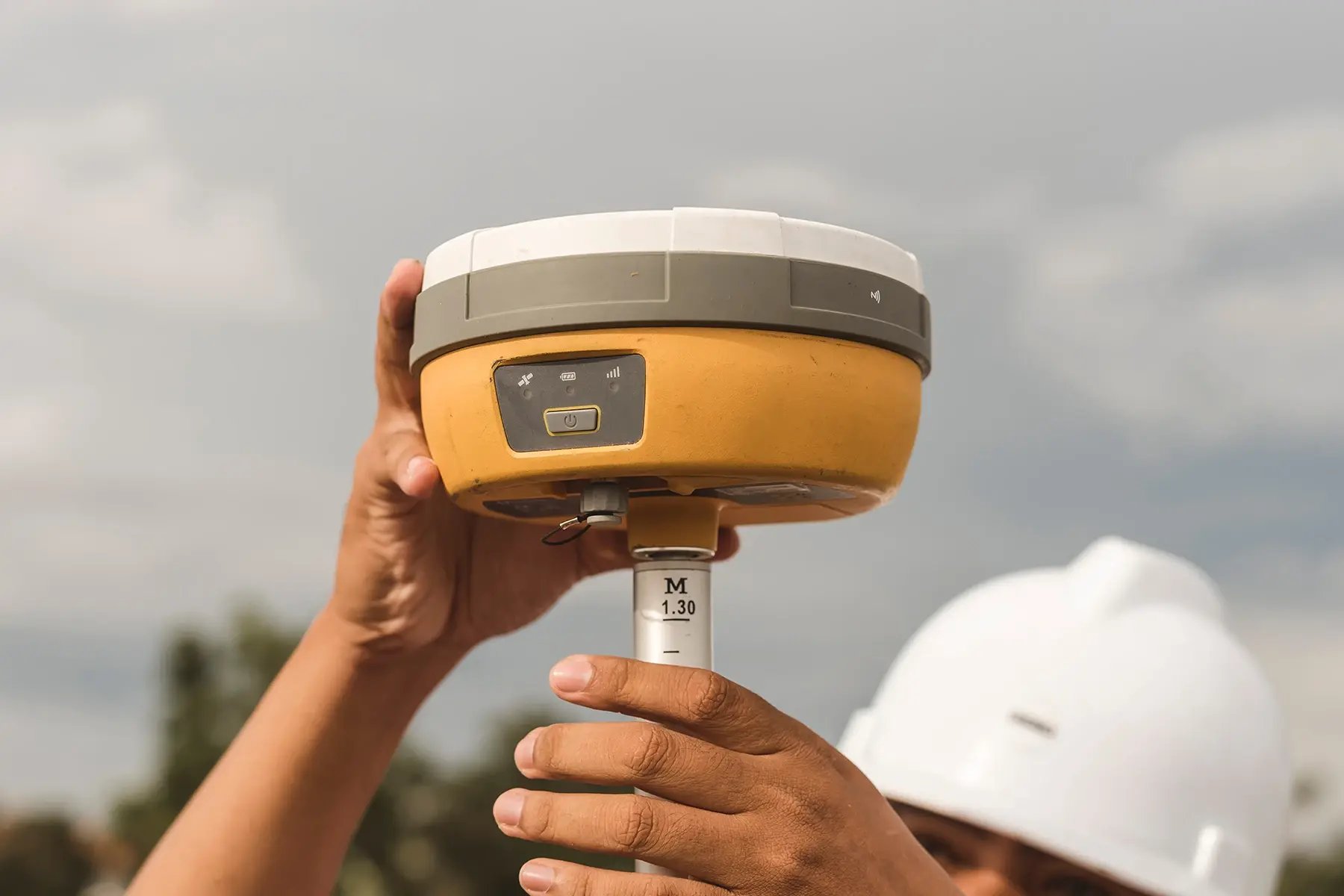
GPS/GNSS Calibration Services
Accurate positioning has become essential infrastructure for modern construction, surveying, marine navigation, oil and gas operations, and automotive testing. Our national network of local calibration providers delivers the precision your industry relies on.
Our GPS/GNSS Calibration Services
Commercial GPS and GNSS systems must deliver precise, verifiable positional accuracy to support project layout, quality control, and regulatory documentation across increasingly demanding applications.
When GPS/GNSS equipment falls out of calibration, the consequences can include inaccurate positioning data, costly rework, project delays, and compliance failures in industries where precision directly affects safety and project outcomes. The Accredited Labs network offers complete GPS and GNSS calibration services to keep your equipment performing within required accuracy ranges.
Why GPS/GNSS Calibration is Essential for Your Operations
Project Accuracy and Quality Control
Construction layout, grading, and surveying all depend on accurate positioning data. Calibrated GPS/GNSS systems ensure that positional measurements translate into accurate fieldwork, reducing costly rework and layout errors on job sites.
Regulatory Compliance and Industry Standards
Heavy civil, marine, oil and gas, and nuclear construction industries increasingly require documented, traceable positioning accuracy as part of quality management systems. ISO/IEC 17025 accredited calibration with NIST-traceable, SI-unit data provides the documentation these industries demand.
Complete System Verification
Because positioning accuracy depends on every component of an RTK system working together, calibrating the base, rover, data collector, and radios as a complete system provides more meaningful assurance than testing components in isolation.
Automotive Testing and Proving Ground Precision
Speed and distance measurements used in vehicle testing and proving ground applications require precise, calibrated GPS data to ensure valid test results and repeatable performance benchmarking.
GPS/GNSS Equipment We Calibrate:
We provide traceable SI data with fast service and minimal downtime. GPS Time Standard is also available. We offer precise speed and distance calibrations for automotive testing and proving grounds. Our services cover all RTK Systems components, including:
- Base
- Rover
- Data Collector
- Radios
- Alignment Laser
- 3D Scanners
- Auto Collimator
- Auto Level
- GPS Receiver
- Multi Target Collimator
- Optical Total Station
- Optical Transit
- Pipe Laser
- Prism Targets
- Prisms
- Theodolite
Find GPS/GNSS Calibration Services
-
Accutek Lab
Accutek Lab has been providing reliable and cost-effective pipette calibration services across the United States since 1996.
Calibration ServicesPipette Calibration -
Aldinger
Since 1972, Aldinger has been providing top-quality calibration services for test and measurement equipment in Texas and beyond.
Calibration ServicesDimensional Calibration Flow Calibration Force Calibration Grain Moisture Tester Calibration Mass Calibration +6 more -
Cal-Cert
Cal-Cert is committed to providing the highest level of calibrations and certification service to our customers.
Calibration ServicesDimensional Calibration Construction Materials Testing Equipment Calibration Electrical Calibration Force Calibration Humidity Calibration +5 more -
Cal-Labs
Cal-Labs has provided quality calibration in Southern California since 1977. We are A2LA accredited to ISO 17025.
Calibration ServicesDimensional Calibration -
Calibration Services Inc.
Calibration Services, Inc. (CSI) is an on-site and in-house calibration firm specializing in calibration and service of mechanical testing devices.
Calibration ServicesForce Calibration Torque Calibration Mass Calibration Dimensional Calibration Pressure Calibration +3 more -
Cal Tec Process Management
The calibration specialists at CTPM have been providing precision calibration and quality assurance since 1987.
Calibration ServicesForce Calibration Torque Calibration Mass Calibration Dimensional Calibration Pressure Calibration +4 more -
Calser Calibrations
Since 1979, Calser Calibrations has delivered trusted, precision calibration services backed by a commitment to quality and reliability.
Calibration ServicesConstruction Materials Testing Equipment Calibration Dimensional Calibration Force Calibration Mass Calibration Pressure Calibration +3 more -
CMG Sales, Inc.
CMG Sales, Inc. is a leading manufacturer sales representative and ISO 17025 accredited calibration laboratory providing services to manufacturers nationwide.
Calibration ServicesCoating Thickness Calibration Color Calibration -
Color Calibration Group
Color Calibration Group has been providing professional calibration services for all your color, light, and viscosity calibration needs for over 25 years.
Calibration ServicesCoating Thickness Calibration Color Calibration -
ETI Precision
ETI has been a leader in the calibration, repair, and sale of test and measurement equipment since 1994, and covers all 50 states.
Calibration ServicesElectrical Calibration Force Calibration Torque Calibration Dimensional Calibration Pressure Calibration +2 more -
Holts Precision, Inc.
For over 60 years Holts Precision, Inc. has performed calibrations & repairs on all major brands of gaging equipment.
Calibration ServicesDimensional Calibration Electrical Calibration Force Calibration Mass Calibration Pressure Calibration +2 more -
Huston-DePue
Established in 1960, HDCL is staffed by experienced professionals who understand the critical role accurate measurement plays in quality control and regulatory compliance.
Calibration ServicesFlow Calibration Force Calibration Torque Calibration Mass Calibration Dimensional Calibration +3 more -
Instrument Technologies, Inc.
For over three decades, Instrument Technologies, Inc. (ITI) has been a trusted partner for regulated industries seeking precision, compliance, and operational reliability.
Calibration ServicesFlow Calibration Mass Calibration Dimensional Calibration Pressure Calibration Time Calibration +1 more -
IPM, Inc.
Industrial Process Measurement, Inc. has been in the instrument supply, service and calibration business for over 30 years.
Calibration ServicesDimensional Calibration Electrical Calibration Flow Calibration Force Calibration Humidity Calibration +6 more -
J & J Calibration Service
J&J Calibration Service, an ISO-17025 accredited company, offers unmatched mobile calibration capabilities and laboratory calibration services.
Calibration ServicesDimensional Calibration Electrical Calibration Force Calibration Pressure Calibration Temperature Calibration +1 more -
OCS Technologies
Founded in 1930, OCS Technologies is a trusted multi-discipline calibration service provider as well as leading product distributor.
Calibration ServicesForce Calibration Torque Calibration Mass Calibration Dimensional Calibration Pressure Calibration +4 more -
OnCal
With over 23 years of experience in pipette calibration in the Pacific Northwest, the OnCal Corporation guarantees seamless and dependable metrology services.
Calibration ServicesPipette Calibration -
Polymer Testing Instruments
Since 1996 Polymer Testing Instruments Inc. has provided high quality service and calibration of equipment for the rubber, plastics, and energy industries.
Calibration ServicesForce Calibration Torque Calibration Dimensional Calibration Pressure Calibration Temperature Calibration +1 more -
Precision Calibration Systems
PCS is a full-service ISO 17025 Accredited calibration laboratory, founded with the goal of providing reliable and accurate instrument calibration service.
Calibration ServicesFlow Calibration Force Calibration Torque Calibration Mass Calibration Dimensional Calibration +5 more -
Quality Control Services
Quality Control Services is an established, accredited calibration services and laboratory equipment company with over 40 years of experience.
Calibration ServicesForce Calibration Mass Calibration Pipette Calibration Temperature Calibration -
Quality Surveillance, Inc.
QSI has been providing Los Angeles, Ventura, Santa Barbara and Santa Clarita Counties with reliable and cost effective metrology services since 1992.
Calibration ServicesDimensional Calibration Force Calibration Mass Calibration Pressure Calibration Temperature Calibration +3 more -
Scale Service & Supply
From laboratory balances to truck scales, Scale Service & Supply has been providing precision calibration for weighing systems since 1987.
Calibration ServicesScale Calibration Mass Calibration -
Servo Innovations
Servo Innovations, founded in 2005, has earned industry-wide trust for its accredited calibration, repair, and technical services.
Calibration ServicesFlow Calibration Force Calibration Torque Calibration Dimensional Calibration Pressure Calibration +2 more -
Tescom Calibration Services
Tescom Calibration Services has provided sales, repair, and calibration of telecom test equipment since 1982.
Calibration ServicesFlow Calibration Force Calibration Torque Calibration Mass Calibration Dimensional Calibration +5 more -
Trident Calibration Labs
Serving the greater Phoenix area, Trident Calibration Labs has more than 100 years of combined calibration experience.
Calibration ServicesElectrical Calibration RF & Microwave Calibration Dimensional Calibration Force Calibration Mass Calibration +6 more -
Tru Cal International
Serving as an asset to countless businesses in a variety of industries, Tru Cal International has specialized in test equipment calibration since 1992.
Calibration ServicesElectrical Calibration Dimensional Calibration Force Calibration Pressure Calibration RF & Microwave Calibration +4 more -
Utah Scale Center
Utah Scale Center offers servicing and calibrating of industrial scales across the Rocky Mountain Region, with 70+ years of experience.
Calibration ServicesScale Calibration -
Washington Calibration
Washington Calibration has been providing customers with quality gage repair services for all their inspection measuring instruments for more than 34 years.
Calibration ServicesDimensional Calibration Force Calibration Mass Calibration Pressure Calibration Temperature Calibration +1 more
No companies found
Try adjusting your filters to see more results.
Request a Calibration Service from the Accredited Labs Network
Audit-Ready Calibration in 3 Simple Steps
Submit Your Equipment List
Send us a list of the equipment you need calibrated, and we’ll provide a tailored quote with clear pricing—no hidden fees.
Schedule Your Calibration
Choose a convenient time for a mobile or on-site equipment calibration. Our certified technicians ensure precision and compliance with ISO/IEC 17025 standards.
Stay Compliant & Audit-Ready
Receive detailed calibration reports and certification, giving you peace of mind for audits and operational excellence.
Frequently Asked Questions
-
What is the difference between GPS and GNSS?
GPS (Global Positioning System) is the United States-operated satellite navigation system — the one most people are familiar with. GNSS (Global Navigation Satellite System) is the broader term that refers to all satellite-based positioning systems worldwide.
In practice, modern positioning receivers are almost always multi-constellation GNSS devices, meaning they simultaneously receive signals from multiple satellite systems rather than GPS alone. This significantly improves positioning accuracy, availability, and reliability — particularly in challenging environments like urban canyons, dense tree cover, or deep construction sites where signal obstruction is a factor.
When we refer to GPS/GNSS calibration, we are calibrating the full positioning system your receiver uses — whether it relies primarily on GPS or draws from multiple GNSS constellations. The calibration process verifies positional accuracy against known reference positions and NIST-traceable standards regardless of which satellite systems the receiver is using. -
What is an RTK (Real-Time Kinematic) system, and why does each component need to be calibrated?
RTK (Real-Time Kinematic) is a satellite positioning technique that dramatically improves the accuracy of GNSS measurements by using a fixed base station to correct the signal errors received by a mobile rover unit — typically achieving centimeter-level positional accuracy in real time.
A complete RTK system consists of several interdependent components:-
Base Station – a fixed receiver set up over a known control point that continuously calculates and broadcasts correction data
-
Rover – the mobile receiver carried or mounted in the field that receives both satellite signals and correction data from the base
-
Data Collector – the field controller or software used to log positions, manage workflows, and store measurement data
-
Radios – the communication link that transmits correction data from the base to the rover in real time
Why does every component need to be calibrated? Because positional accuracy is only as good as the weakest link in the system. An error introduced by a misconfigured base station, a data collector with incorrect antenna offsets, or a radio causing communication latency will propagate through the entire positioning solution — often invisibly, with no warning to the operator.
Calibrating the RTK system as a whole — not just individual components in isolation — is what produces meaningful, defensible positional accuracy data. -
-
What is positional accuracy, and how is it measured?
Positional accuracy describes how closely a GPS/GNSS system's reported position matches the true position of a point on the ground. It is typically expressed as a distance indicating the radius within which the true position is expected to fall with a defined level of statistical confidence.
Positional accuracy has two primary components:- Horizontal accuracy – how accurately the system locates a point in the X/Y plane (latitude and longitude)
- Vertical accuracy – how accurately the system determines elevation (Z axis); vertical accuracy is typically two to three times worse than horizontal accuracy for most GNSS systems
How is positional accuracy measured? During calibration, we compare the GPS/GNSS system's reported positions against precisely established reference points with known, survey-grade coordinates. The differences between reported and known positions are measured, analyzed statistically, and reported in SI units with NIST traceability.
Several factors affect the positional accuracy a system can achieve in the field, including:-
Number and geometry of visible satellites (PDOP — Position Dilution of Precision)
-
Multipath interference from nearby structures or terrain
-
Atmospheric conditions affecting signal propagation
-
Baseline distance between the RTK base station and rover
-
Equipment quality and firmware version
-
How often should GPS/GNSS equipment be calibrated?
Calibration frequency for GPS/GNSS equipment depends on several factors: the industry you operate in, the criticality of positioning accuracy to your work, how frequently the equipment is used, and whether the equipment has been subjected to any event that could affect its performance.
General guidelines by application:-
Construction and surveying: Most contractors and survey firms calibrate RTK systems annually, or at the start of a major project where positional accuracy documentation will be required. Equipment used daily in demanding field conditions may warrant more frequent intervals.
-
Oil and gas and marine: Quality management systems in these industries often require calibration at defined intervals specified in the project quality plan — typically annually, but sometimes more frequently for critical applications.
-
Nuclear construction: Calibration intervals are formally specified in the project quality assurance program and are non-negotiable. Equipment may need to be calibrated before use on a specific project regardless of its last calibration date.
-
Automotive testing: Proving ground applications typically calibrate GPS systems before a test campaign or on a schedule defined by the testing protocol.
Beyond scheduled intervals, GPS/GNSS equipment should also be recalibrated after:
-
Any significant physical impact or drop
-
Firmware or software updates that affect positioning calculations
-
Antenna replacement or changes to antenna height/offset settings
-
An out-of-tolerance finding on a previous calibration
-
Extended storage or periods of non-use
If you are unsure what interval is appropriate for your specific equipment and application, we can help you evaluate your situation and establish a calibration schedule that supports your quality management system and project requirements.
-