

 Joe Moser - CEO
Metrology is the science of measurement, and it sits behind nearly every decision a business makes based on a number: whether a part is within tolerance, whether a batch is safe to release, whether a reading meets a regulatory limit. Metrology services put that science into practice, verifying that the instruments producing those numbers can actually be trusted.
For quality managers, engineers, and procurement teams evaluating a calibration partner, this article covers what metrology services actually involve, the disciplines they span, the standards that govern them, and the industries that depend on them to keep measurement defensible.
What Is Metrology?
Metrology is the science of measurement and its application, covering everything from the definition of measurement units to the practical work of verifying that an instrument reads accurately. NIST, the United States' national metrology institute, describes its own metrology work as advancing measurement science to support economic security and quality of life, a mission that touches manufacturing, healthcare, energy, and nearly every other sector of the economy.
Metrology and calibration are related but distinct. Metrology is the underlying science: the study of measurement units, uncertainty, and traceability. Calibration is metrology applied to a specific instrument, comparing it against a known reference standard to verify or adjust its accuracy. A metrology services provider performs calibration, but the accuracy of that calibration depends on metrology principles like traceability and measurement uncertainty being handled correctly behind the scenes.
What Capabilities Do Metrology Services Cover?
Metrology spans far more ground than most people expect, because nearly every physical quantity that can be measured has its own calibration discipline behind it. Common capability areas include:
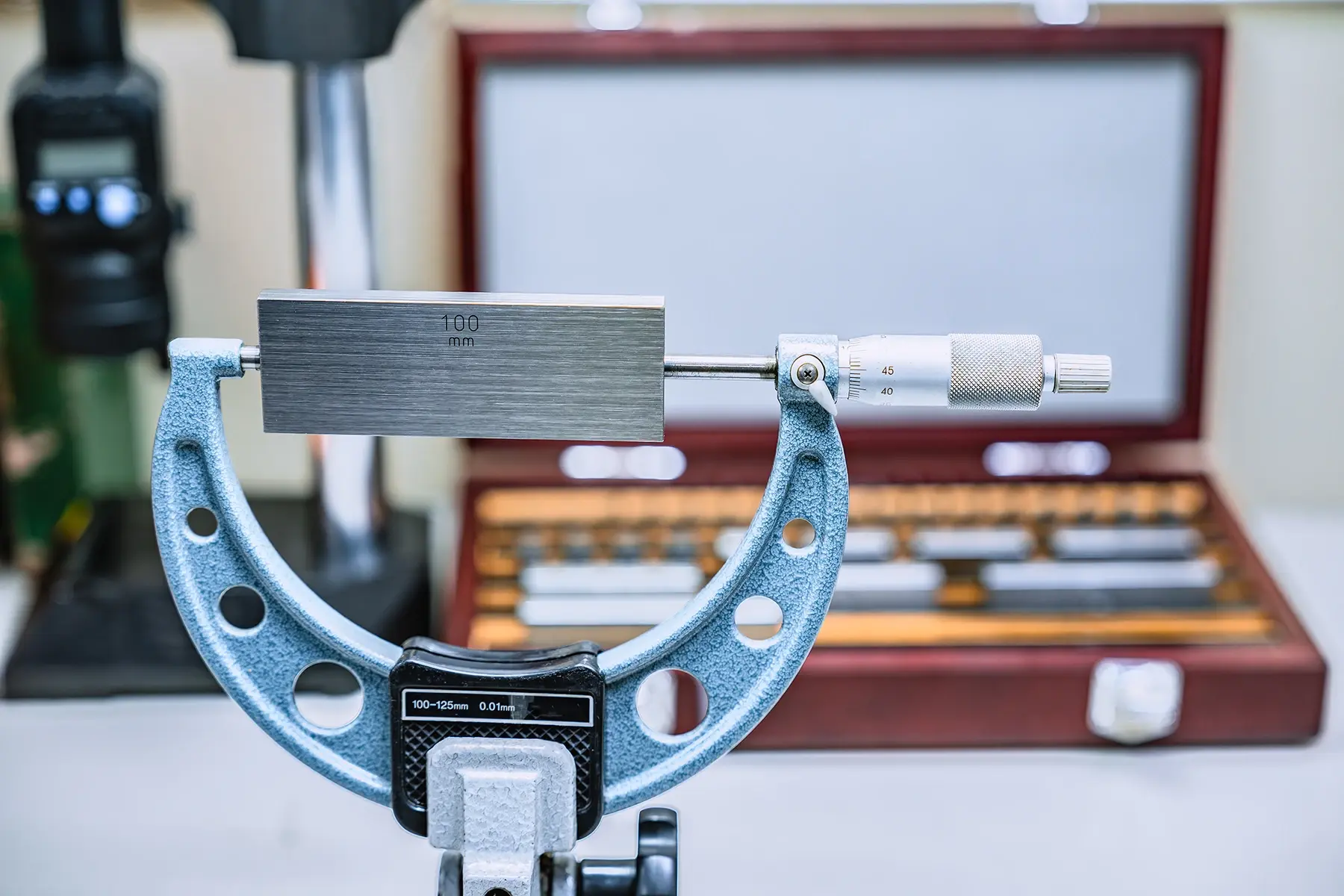
- Dimensional metrology, covering calipers, micrometers, gage blocks, coordinate measuring machines, and other tools that measure length, geometry, and form.
- Mechanical metrology, including force, torque, mass, and pressure calibration for instruments used in materials testing, manufacturing, and process control.
- Electrical and RF metrology, covering multimeters, power supplies, network analyzers, and other instruments measuring voltage, current, frequency, and signal parameters.
- Thermal metrology, including temperature, humidity, and infrared temperature calibration for instruments used in process control, environmental monitoring, and quality testing.
- Flow metrology, covering flow meters and related instrumentation used in chemical processing, water treatment, and energy applications.
- Time and frequency metrology, covering atomic clocks, frequency counters, and timing equipment used for synchronization across telecommunications and other industries.
- Specialized disciplines, including GPS/GNSS calibration, optical and vision system calibration, color calibration, proof load testing for lifting equipment, grain moisture testing, and construction materials testing equipment calibration.
A provider's ability to cover multiple disciplines under one accreditation, rather than requiring a facility to coordinate with several single-discipline vendors, is often what separates a genuine metrology services provider from a narrower calibration shop.
How Does Metrology Ensure Traceability?
Traceability is the concept that makes a calibration result meaningful beyond the walls of the lab that performed it. According to NIST, metrological traceability requires an unbroken chain of calibrations linking a measurement result back to a specified reference standard, typically a national or international realization of a unit in the International System of Units (SI).
In practice, that means an instrument calibrated at a local lab should trace back through that lab's reference standards, which in turn trace back to standards maintained by NIST or an equivalent national metrology institute. Each link in that chain carries its own documented uncertainty, and a break anywhere in the chain undermines the traceability claim for everything downstream of it.
This is why a calibration certificate is worth more than a pass or fail statement. A certificate that documents the reference standard used, the measurement uncertainty, and a clear traceability statement is what allows a customer, auditor, or regulator to trust a number without repeating the measurement themselves.
What Standards Govern Metrology Services?
ISO/IEC 17025 is the international standard that governs the competence of testing and calibration laboratories, and it's the standard most directly relevant to metrology service providers. A laboratory accredited to ISO/IEC 17025 has had its technical competence, equipment traceability, and quality management system independently evaluated by trained assessors against that standard.
Accreditation is granted by scope, not as a blanket credential. A lab accredited for dimensional calibration isn't automatically qualified for electrical or RF calibration, which is why confirming a provider's accreditation scope against the specific discipline you need is a necessary step, not a formality.
ISO/IEC 17025 accreditation isn't a universal legal requirement for every measurement application, but it is the most reliable way to demonstrate that a metrology services provider's results, documentation, and reference standards will hold up under a customer audit or regulatory review.
What Industries Rely on Metrology Services?
Metrology services support measurement accuracy across a wide range of industries, each with its own accuracy requirements and regulatory context. Common industries include:
- Aerospace and defense, where measurement accuracy affects flight safety, mission success, and national security.
- Automotive, where precision manufacturing and safety engineering depend on consistent measurement across suppliers.
- Chemical manufacturing, where precise formulations and hazardous material handling demand tightly controlled measurement.
- Construction materials and machinery, where testing equipment accuracy underlies infrastructure safety and structural integrity.
- Energy, where measurement accuracy affects grid reliability and public safety.
- Food and beverage, where measurement supports safety and quality across production.
- General manufacturing and machinery and equipment production, where measurement accuracy separates profit from waste.
- Medical and healthcare services, along with pharmaceuticals and life sciences, where calibration directly affects patient safety and product quality.
- Semiconductors and electronics, where manufacturing tolerances leave little room for measurement error.
- Educational institutions, engineering and R&D organizations, plastics and rubber manufacturers, and public administration and government agencies, each with measurement needs specific to their work.
Any organization whose operations, safety decisions, or compliance obligations depend on a physical measurement is, in some form, a consumer of metrology services.
Why Does Metrology Matter for Compliance and Quality?
Metrology matters because nearly every quality and compliance claim a business makes eventually traces back to a measurement, and that measurement is only as good as the instrument and process behind it. A dimensional measurement that's off can mean a part doesn't fit. A pressure reading that's off can mean a safety system doesn't trigger when it should. A mass measurement that's off can mean a formulation is wrong.
Documented, traceable metrology work is what allows a business to demonstrate, rather than simply assert, that its measurements are accurate. That documentation is what supports internal quality systems, customer audits, and regulatory submissions across every industry listed above.
How Do You Choose a Metrology Services Provider?
Choosing a metrology services provider comes down to a handful of factors beyond price and turnaround time. Before selecting one, ask:
- Does the provider's accreditation scope specifically cover the measurement disciplines and instrument types you need calibrated?
- Can the provider demonstrate traceability to NIST or an equivalent national metrology institute for its reference standards?
- Does the provider cover enough disciplines to consolidate your calibration program, or will you still need multiple vendors?
- What documentation does the provider issue, and does it include stated measurement uncertainty and a clear traceability statement?
- Does the provider offer consistent service across multiple locations if your organization operates at more than one site?
A nationwide accredited network offers a real advantage here, giving organizations with multiple sites and multiple measurement disciplines consistent quality and documentation practices, rather than coordinating across several narrower, single-discipline providers.
Accurate Measurement Is the Foundation Everything Else Is Built On
Every quality decision, safety system, and compliance record that depends on a measurement is only as reliable as the metrology behind it. A documented, accredited metrology program is what keeps that foundation solid across every discipline and every industry that depends on it.
At Accredited Labs, our nationwide network performs metrology services across dimensional, mechanical, electrical, thermal, flow, time, and specialized calibration disciplines under ISO/IEC 17025 accredited practices.
→ Get A Metrology Services Quote