


5 min read
How Environmental Conditions Affect Grain Moisture Tester Readings
 Joe Moser - CEO
Published
Joe Moser - CEO
Published
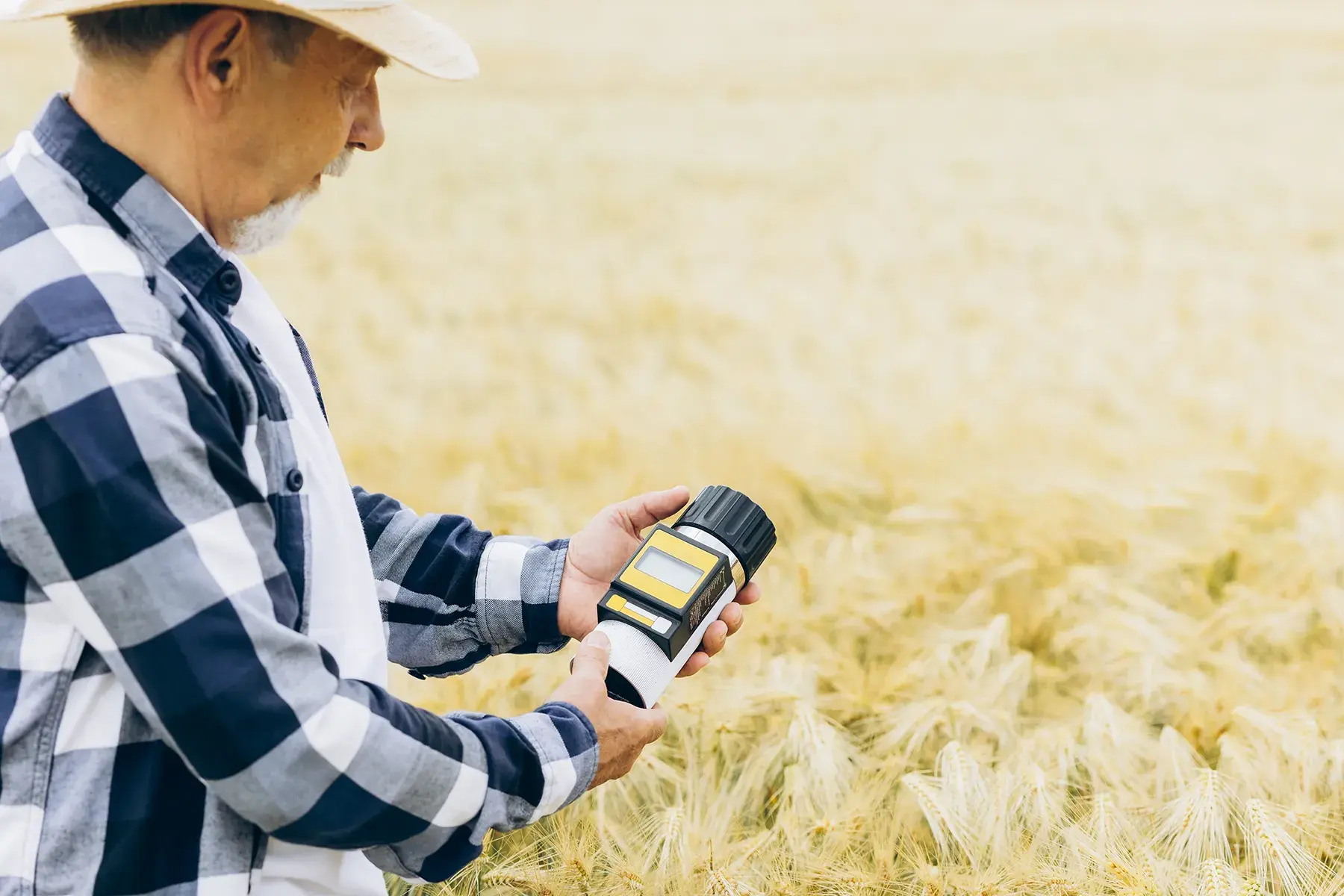
A grain moisture tester that's been reliable all season can start returning readings that are subtly, consistently off, without a single visible sign that anything has changed. For an instrument that directly affects grading, pricing, and storage decisions, that kind of quiet inaccuracy carries real financial and quality risk.
Grain moisture testers face two distinct accuracy challenges that often get confused with one another: long-term drift in the instrument itself, and short-term measurement error caused by the environmental conditions present at the moment of testing. Understanding the difference is what separates an operation that catches a real problem early from one that spends a season chasing readings that were never wrong to begin with.
What Is Drift in a Grain Moisture Tester?
Drift is the gradual change in an instrument's calibration relative to a true reference value, occurring independently of any single test. A moisture tester that read accurately at the start of harvest can be measuring consistently high or low by the end of it, even though nothing about how it's being operated has changed.
This is different from the moment-to-moment variation caused by environmental conditions, discussed below. Drift is a property of the instrument itself: its sensor, its internal reference, and its calibration curve degrading over time. Environmental effects are a property of the measurement conditions at the time of the test, and they can affect even a perfectly calibrated instrument.
What Causes Grain Moisture Testers to Drift?
Several mechanisms drive long-term drift in moisture testing equipment.
Sensor and electrode aging affects capacitance-based and conductance-based moisture meters alike. The electrodes or plates that measure a grain sample's electrical properties can accumulate residue, oxidation, or physical wear from repeated contact with grain, dust, and chaff, gradually shifting the relationship between what the sensor measures and the moisture value it reports.
Calibration curve degradation is specific to grain moisture testing in a way that doesn't affect simpler instruments. Moisture meters rely on calibration curves that convert an electrical measurement into a moisture percentage for a specific grain type, and those curves can be less accurate if the instrument's underlying sensor response has shifted, even when the meter is still using the correct curve for the grain being tested.
Mechanical wear in the test chamber, hopper, or compression mechanism used to load a sample introduces error that looks like drift over time. A chamber that no longer compresses grain to a consistent, repeatable density will produce inconsistent readings regardless of the sensor's own condition, since most moisture testing methods assume a specific sample density.
Internal reference component aging, similar to other electronic test equipment, affects the stability of the internal reference the instrument uses to translate raw sensor signal into a displayed value. This kind of drift is invisible during normal operation since the instrument continues to display a number with no indication that the underlying reference has shifted.
Usage intensity during peak season compounds all of these mechanisms. A meter used dozens or hundreds of times a day during harvest accumulates mechanical wear and electrode fouling far faster than one used occasionally, which is part of why in-season verification matters more for moisture testers than for many other instrument types.
How Do Environmental Conditions Affect Grain Moisture Readings?
Separate from instrument drift, environmental conditions at the time of testing can shift a moisture reading even when the instrument itself is perfectly calibrated.
Grain temperature has an outsized effect on most moisture testing methods. Capacitance-based meters in particular are sensitive to the temperature of the grain sample itself, not just the ambient air, and grain pulled directly from a hot truck bed or a cold outdoor pile can produce a different reading than the same grain allowed to reach a stable temperature first. Many meters include a temperature compensation function, but that compensation has its own limits and doesn't fully eliminate the effect at temperature extremes.
Ambient temperature and humidity around the instrument itself can affect the electronics inside the meter, separate from the grain sample's own temperature, particularly for equipment used in unconditioned spaces like a grain elevator or a truck scale house.
Sample handling and moisture migration introduce error before the grain ever reaches the instrument. Grain that has been sitting in a pile or a truck bed can have moisture unevenly distributed between its surface and interior, and a sample pulled from the surface alone can read differently than a properly mixed, representative sample.
Static electricity and dust, common in grain handling environments, can interfere with capacitance-based sensors specifically, introducing noise into a reading that has nothing to do with either the instrument's calibration or the grain's actual moisture content.
What's at Risk When Moisture Readings Are Wrong?
Whether the cause is instrument drift or environmental interference, an inaccurate moisture reading creates consequences that extend well beyond a single test.
Grading and pricing disputes are the most immediate risk. Grain moisture content directly affects grade, price, and dockage calculations, and a meter reading even slightly outside its accuracy tolerance can systematically overpay or underpay across an entire season's volume without anyone noticing the pattern until it's reviewed after the fact.
Storage and spoilage risk follows closely. Grain stored based on an inaccurate moisture reading, believed to be drier than it actually is, is at meaningfully higher risk of mold, heat damage, and spoilage in storage, a risk that scales with the volume stored on the basis of that reading.
Regulatory and contract compliance exposure rounds out the risk. Moisture testing equipment used in grain trading and grain elevator operations is often subject to state weights-and-measures oversight or contract-specified testing methods, and a drifted or improperly used meter can put an operation out of compliance without any deliberate wrongdoing involved.
How Do You Catch Both Problems Before They Cost You?
As an ISO/IEC 17025 accredited company, we can't tell you what calibration interval is right for your equipment; that decision depends on your usage, criticality, and risk tolerance. What we can point to is the practice that separates real instrument drift from environmental measurement error, and catches both.
As-found data at every calibration is the clearest way to track genuine drift over time. A meter that shows a consistent, growing offset from a reference value across successive calibrations is drifting; a meter that varies inconsistently from test to test is more likely dealing with environmental or sample-handling variation.
Periodic verification against a reference method, such as the oven-drying method used as the standard reference for grain moisture, gives an operation an independent check between full calibrations, particularly valuable during peak season when usage intensity is highest.
Consistent sample handling, including allowing grain to reach a stable temperature before testing and pulling a properly representative sample, removes one of the largest sources of environmental measurement error before it ever reaches the instrument.
Tracking which meter produced which reading, and cross-checking meters against each other periodically when more than one is in use, can surface a single drifting unit that would otherwise blend into normal test-to-test variation.
What Should a Grain Moisture Calibration Provider Verify?
A provider calibrating grain moisture testing equipment should verify performance against multiple reference points across the meter's working range and, where applicable, across the specific grain calibration curves your operation relies on, rather than a single generic check. Look for a provider that documents full as-found and as-left data and reports results in a way that lets you track drift over successive calibrations rather than a bare pass or fail.
Confirming that a provider's accreditation scope specifically covers grain moisture testing equipment, rather than assuming general calibration accreditation extends to this specialized instrument type, is worth verifying before committing to a provider.
Two Different Problems, One Disciplined Process
Grain moisture tester drift and environmental measurement error are easy to lump together, but they call for different responses: drift is addressed through calibration and as-found data tracked over time, while environmental effects are addressed through consistent sample handling and testing conditions. A disciplined program accounts for both instead of attributing every inconsistent reading to whichever explanation is easiest to reach for.
At Accredited Labs, our nationwide network performs grain moisture tester calibration under ISO/IEC 17025 accredited practices, with full as-found and as-left data to help you track drift and keep your readings defensible all season long.