

6 min read
Force Calibration Explained: Load Cells, Proving Rings, and Compression Systems
 Joe Moser - CEO
Updated on July 28, 2026
Joe Moser - CEO
Updated on July 28, 2026
What Is Force Calibration?
Force calibration is the process of verifying that an instrument measuring force — whether in compression, tension, or both — reads accurately against a traceable reference standard. Like all calibration, it establishes a documented link between your instrument's output and a known, defensible measurement chain that traces back to national standards maintained by NIST.
For lab managers and quality managers, force calibration isn't an abstract concept. It's the difference between test data you can defend and test data you can't. When a load cell is out of tolerance, every measurement it produced during that period is suspect. When a proving ring hasn't been calibrated on a documented schedule, it can't anchor the accuracy of the testing machine it's verifying.
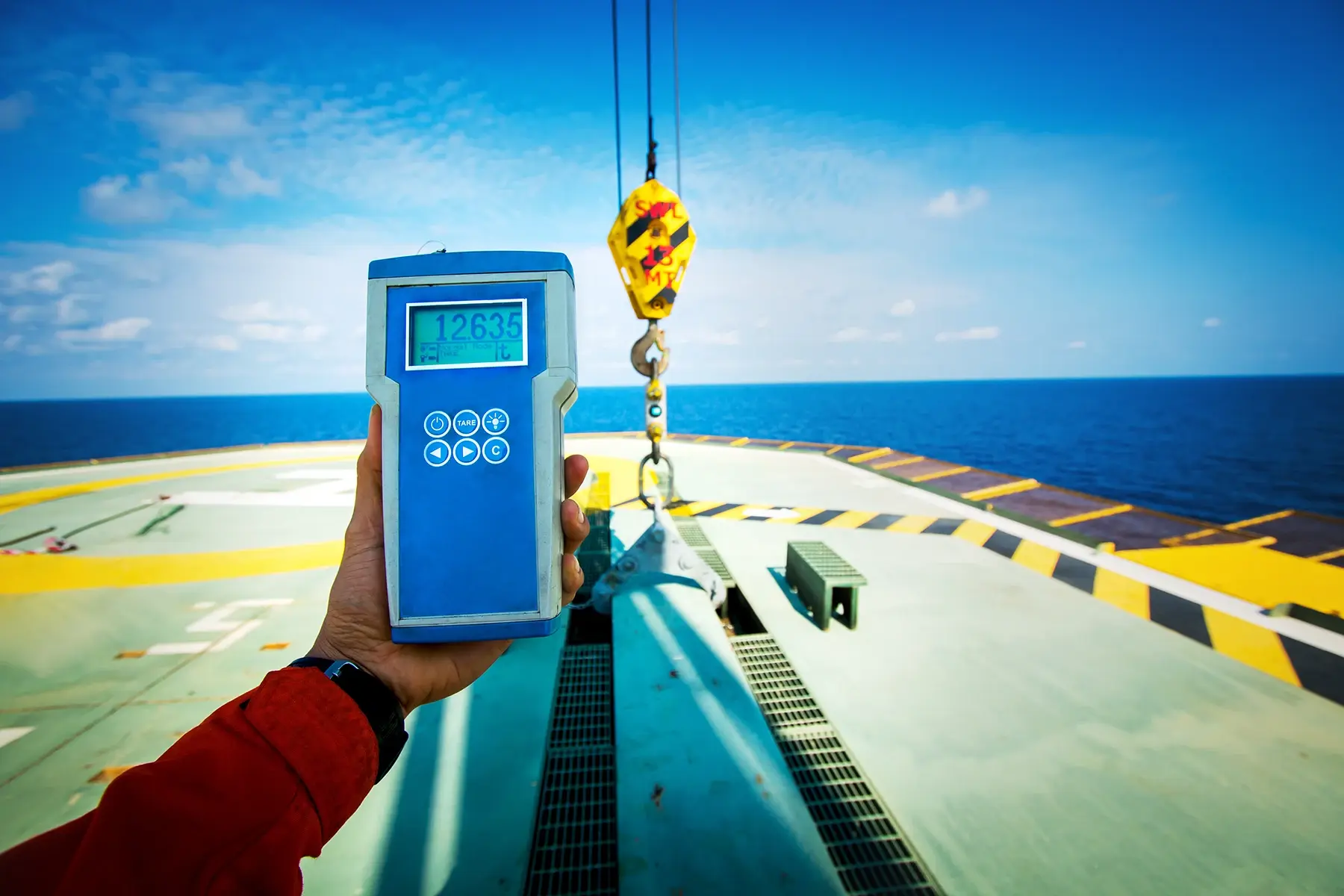
Force measurement underlies a wide range of critical testing applications — materials testing, structural load verification, compression testing of concrete and asphalt specimens, torque-force relationships, proof load testing of lifting equipment, and more. In each case, the reliability of the result depends on the calibration status of the force measurement instrument at its core.
How Force Calibration Works
Force calibration compares the output of your instrument against a reference standard of known accuracy under controlled, documented conditions. The reference standard itself carries a calibration certificate traceable to NIST, creating the unbroken measurement chain required by ISO/IEC 17025 and most quality frameworks.
The general process follows these steps:
The instrument is documented — make, model, serial number, calibration history, and current condition are recorded before any measurements are taken.
As-found data is collected — measurements are taken across the instrument's operating range before any adjustment. This step is critical. As-found data tells you how the instrument was performing during the period since its last calibration, and it's the data that supports or undermines the validity of measurements taken during that period.
The instrument is evaluated against tolerance — if readings fall outside the manufacturer's or application's specified tolerance, the instrument is adjusted, repaired, or removed from service.
As-left data is recorded — measurements are taken after any adjustment to confirm the instrument now performs within tolerance.
A calibration certificate is issued — documenting the reference standards used, the calibration points tested, measurement uncertainty, and traceability chain.
For force instruments, calibration is typically performed at multiple points across the operating range — not just at a single load. This is consistent with ASTM E74 (calibration of force-measuring instruments) and ASTM E4 (force verification of testing machines), both of which require multi-point verification to characterize instrument behavior across the range in use.
Load Cells: The Most Common Force Measurement Device
A load cell is a transducer that converts an applied force into an electrical signal. They appear in virtually every application where force needs to be measured or controlled — universal testing machines, compression testers, tension testers, industrial scales, and process monitoring equipment.
Load cells are precise instruments, but they're also sensitive ones. Several factors affect their accuracy over time and require regular calibration attention:
Mechanical overload. Exceeding a load cell's rated capacity — even briefly — can permanently shift its calibration. A load cell that was overloaded may appear to function normally while producing systematically incorrect readings.
Temperature effects. Load cells are sensitive to temperature changes. Most are designed with temperature compensation, but that compensation has limits. Instruments used across wide temperature ranges or in thermally unstable environments need more frequent calibration scrutiny.
Fatigue and creep. Load cells subjected to repeated cycling or sustained loads over time can exhibit drift. Calibration history — particularly as-found data at successive intervals — is the best indicator of whether an instrument is stable or deteriorating.
Connector and cable integrity. Signal conditioning and cabling affect the output of a load cell system. Calibration of the full measurement chain, not just the sensor element, is the correct approach for systems where cable runs or signal conditioning are part of the measurement path.
Proving Rings: The Reference Standard for Force Verification
A proving ring is a precision elastic device — typically a machined steel ring with a calibrated deflection indicator — used as a reference standard for verifying the force output of testing machines. When you're verifying that a compression testing machine applies the load it claims to apply, a proving ring is often the instrument doing the verification.
Because proving rings serve as reference standards rather than routine measurement instruments, their calibration requirements are particularly stringent. A proving ring that's out of calibration doesn't just produce bad data for one test — it undermines the validity of every machine verification performed with it.
Key considerations for proving ring calibration:
Proving rings are calibrated under ASTM E74, which establishes the procedures for calibrating force-measuring instruments intended for use as secondary standards. The certificate issued under E74 includes a calibration equation and loading and reloading error data that define the instrument's accuracy class.
Proving rings have defined classification levels. ASTM E74 defines Class A and Class B instruments, with Class A representing higher accuracy. The classification determines the minimum force range over which the proving ring can be used as a reference standard.
Temperature and aging affect proving rings. Steel proving rings are sensitive to temperature at calibration and use. Most should be recalibrated annually, and any ring that has been overloaded, dropped, or subjected to unusual stress should be recalibrated before further use as a reference.
Calibration interval matters for traceability. If a proving ring's calibration has lapsed, the machine verifications performed with it during that lapsed period lack a valid traceability chain. For quality managers maintaining compliance under ISO/IEC 17025 or similar frameworks, this is an audit risk that's entirely preventable.
Compression Systems: Calibration Across the Full Load Path
Compression testing systems — whether used for concrete cylinders, asphalt specimens, masonry units, or other construction materials — apply a measured compressive load and report the result. The accuracy of that result depends on the calibration of the force measurement system within the machine.
ASTM E4, the standard governing force verification of testing machines, requires that compression machines be verified at intervals not exceeding 18 months, or whenever the machine is relocated, repaired, or gives results that are questionable. Verification is performed using a calibrated force-measuring instrument — typically a load cell or proving ring — that meets the accuracy requirements of ASTM E4.
For lab managers running construction materials testing programs, a few practical points:
Verification and calibration are related but distinct. Calibrating the reference load cell or proving ring is not the same as verifying the testing machine. Both steps are required. The reference instrument must have a current, valid calibration certificate before it can be used to verify the machine.
The full operating range matters. ASTM E4 requires verification across the range in which the machine will be used. A machine verified only at high loads has no documented accuracy at lower loads — which matters when testing lower-strength specimens.
Digital readouts and software add complexity. Modern compression systems often pair a force transducer with digital display or data acquisition software. Calibration needs to account for the full signal path — from load application through transducer, signal conditioning, and display — not just the mechanical elements.
Frame condition affects calibration validity. A machine with a bent platen, worn bearings, or misaligned loading surfaces may pass a load cell verification while still producing unreliable results due to non-axial loading. Calibration and machine condition inspection should go together.
What Standards Govern Force Calibration?
For lab and quality managers maintaining a compliant measurement program, the key standards to know are:
ASTM E4 — Force Verification of Testing Machines. The primary standard for verifying that a testing machine applies the force it indicates. Required for compression and universal testing machines used in materials testing.
ASTM E74 — Calibration of Force-Measuring Instruments for Verifying the Force Indication of Testing Machines. Governs the calibration of load cells and proving rings used as reference standards under E4.
ISO 376 — the international equivalent to ASTM E74, used in calibration programs aligned to international standards rather than ASTM.
ISO/IEC 17025 — the overarching standard for calibration laboratory competence. If your calibration provider is ISO/IEC 17025 accredited for force calibration, their certificates carry the traceability and uncertainty documentation required by most quality and regulatory frameworks.
How Often Should Force Instruments Be Calibrated?
The right interval depends on the instrument type, its role, and the demands of the application — but some general guidance applies:
Load cells used in routine testing should be calibrated at least annually. Instruments in high-cycle applications, or those that have experienced overload or unusual conditions, should be calibrated more frequently or immediately following the event.
Proving rings used as reference standards should be calibrated annually. Given their role in verifying other instruments, a lapsed proving ring calibration has downstream consequences for every machine it was used to verify.
Compression testing machines under ASTM E4 must be verified at intervals not exceeding 18 months, after relocation or significant repair, and whenever results are in question.
Your own calibration history is the most useful guide. If as-found data consistently shows an instrument arriving in tolerance with margin to spare, you have evidence-based grounds to consider extending the interval. If as-found data shows frequent out-of-tolerance results, the interval should be shortened and the root cause investigated.
Signs Your Force Instruments May Need Attention Now
Don't wait for a scheduled calibration if you're seeing:
- Test results that are inconsistent with expected material properties or process behavior
- A testing machine that has been relocated, repaired, or involved in an overload event
- A proving ring or load cell that was dropped or subjected to shock
- Calibration certificates that are expired or approaching expiration
- An upcoming audit or customer quality review that will require current calibration documentation
- Failed specimens or outlier results that can't be explained by material variability alone
Work With a Calibration Provider Who Understands Force Measurement
Force calibration requires more than a certificate. It requires a provider who understands the standards, the instruments, and the measurement applications — and who can match calibration scope to what your quality program actually requires.
Accredited Labs provides force calibration services through a national network of ISO/IEC 17025 accredited laboratories, with on-site calibration capabilities for testing machines and equipment that can't be removed from service.
→ Get a force calibration quote