

 Joe Moser - CEO

Most construction materials testing labs don't fail audits because they don't care about calibration. They fail because calibration management is harder to stay on top of than it looks. Equipment quietly drifts past its due date, certificates get filed without being checked, and correction factors get applied inconsistently across technicians.
Then the assessor walks in, and a problem that should have taken 20 minutes to fix becomes a formal finding that follows your lab for the next accreditation cycle.
This post is about closing that gap. We'll walk through the critical calibration requirements for CMT equipment — concrete, asphalt, aggregate, and soil — and share a checklist that will let you walk into any audit with confidence.
The Audit Finding You Don't See Coming
Ask any experienced lab manager what surprises them most about audit deficiencies, and they'll tell you the same thing: it's rarely the big stuff. It's the compression machine that was calibrated 13 months ago instead of 12. It's the gyratory calibration log that shows the angle was verified but doesn't document who did the verification or what reference standard was used. It's the NCAT oven correction factor that was updated for the previous aggregate source but never revised when the mix design changed.
None of these are exotic failures. They're the predictable result of running a busy lab where calibration feels like it's under control — right up until it isn't.
Under ISO/IEC 17025:2017 and AASHTO R 18, your calibration program isn't just about having certificates on file. It's about demonstrating a documented, traceable, consistently applied system. Assessors aren't just checking whether your equipment was calibrated. They're checking whether your lab understands its calibration requirements and can prove it.
What "Audit-Ready" Actually Means for CMT Equipment
Audit readiness in a CMT lab isn't a single event — it's a state of ongoing operational discipline. But if you had to distill it down to what assessors actually scrutinize, it comes down to four things:
1. Current, traceable calibration for every instrument in active use. Every piece of equipment used to generate test data needs a current calibration certificate, and that certificate needs to trace back to a national measurement standard (NIST in the U.S., or an equivalent NMI). "Current" means within your defined calibration interval — not just "we think it was done recently."
2. Certificates that contain all required information. A calibration certificate isn't just a piece of paper saying the equipment passed. Under ISO/IEC 17025, it needs to include the measurement results, expanded uncertainty at k=2, an as-found/as-left statement, the reference standard used, and the accreditation scope of the calibrating lab. Missing any of these makes the certificate essentially unusable for accreditation purposes.
3. Evidence that calibration data is being used. This is the one labs most often get caught on. If your compression machine has a correction factor, are your technicians actually applying it in test reports? If your NCAT oven was calibrated with a correction factor for a specific mix, is that factor being tracked as aggregate sources change? Calibration only protects you if it's integrated into your testing workflow — not just filed in a drawer.
4. A system for managing intervals and triggering recalibration. Equipment doesn't just need to be calibrated on a schedule. It needs to be recalibrated when something changes — when it's moved, repaired, dropped, or when test results start looking inconsistent. Your QMS needs to define these triggers, not just a calendar frequency.
The Equipment That Gets Labs Into Trouble Most Often
Based on the most common findings across ISO/IEC 17025 and AASHTO assessments, these are the CMT instrument categories that account for the majority of calibration-related deficiencies:
Compression Testing Machines
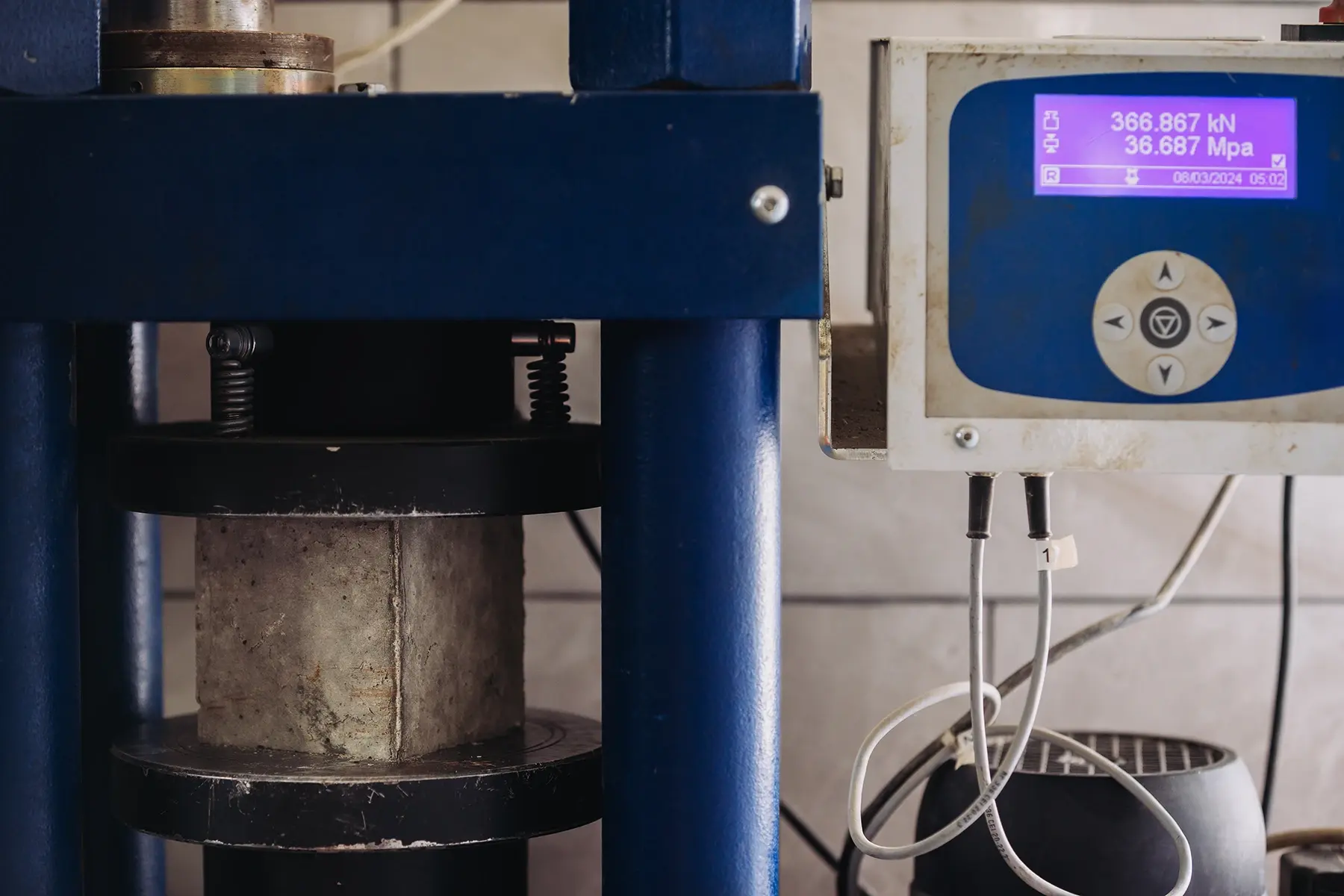
The single most frequently cited item in CMT audits. ASTM E4 requires annual verification of load-indicating systems, but labs often miss the nuance: platen flatness and spherical bearing function are part of the calibration, not just the load cell. An impact event, such as a specimen that failed explosively or a hard bump during transport, is a recalibration trigger regardless of where you are in your annual cycle.
Gyratory Compactors
The angle of gyration has to be verified, not just set. There's a meaningful difference between "we set the angle to spec" and "we verified the angle against a calibrated reference and documented the result." AASHTO T 312 requires the latter. Labs running high volumes should be verifying more frequently than annually.
Sieves
Sieve calibration often falls through the cracks because sieves feel like passive, low-stakes equipment. They're not. ASTM E11 requires periodic verification of opening sizes, and the retirement threshold is reached faster than most labs expect, especially on fine sieves used for gradation work. The frequency trigger isn't just time; it's test cycles.
Proctor Hammers
The rammer face condition is a critical check that should happen every time the hammer is used, not just at annual calibration. A worn face changes the effective contact area and therefore the compaction energy delivered to the specimen. ASTM D698/D1557 is explicit about this. Replacing a rammer face without recalibrating the hammer assembly is a common finding.
Scales and Balances
Scales need multi-point linearity verification with ASTM Class F weights, but platform scales also require a corner load test, checking that loads placed off-center read accurately. This is frequently skipped, and assessors know to ask for it.
Work With a Calibration Partner Who Knows CMT
Staying audit-ready is a lot easier when your calibration provider understands the specific demands of construction materials testing.
The Accredited Labs network provides ISO/IEC 17025-accredited calibration for the full range of CMT equipment, with documentation built to satisfy AASHTO, A2LA, and state DOT requirements. Our technicians work with CMT labs every day, which means they know where the audit findings tend to show up — and how to make sure your certificates hold up under scrutiny.
Find your nearest Accredited Labs branch →